What Does "Beyond Living Memory" Actually Mean?
Cast your mind back to a conversation with a grandparent or elderly relative — perhaps they told you about rationing during World War Two, or what life was like before the internet. That is living memory: history that someone alive today can personally recall and recount.
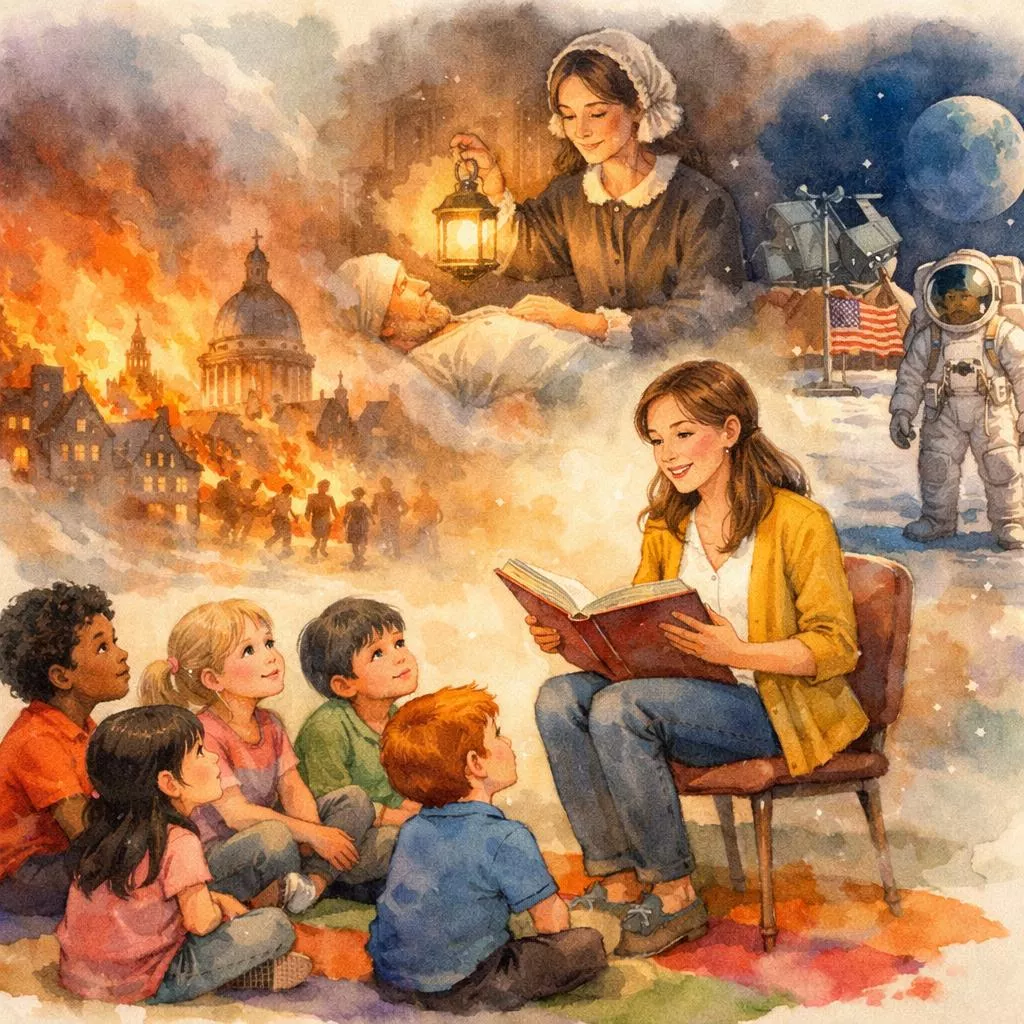
Beyond living memory is everything that happened before anyone alive today could possibly remember it. It is the world of Samuel Pepys watching London burn, of Jack Phillips tapping out distress signals on the Titanic, of Florence Nightingale walking lantern-lit wards in Scutari. These are events and people that children can only access through the traces they left behind — documents, objects, images, stories, and buildings.
Understanding this distinction is genuinely significant for young learners. It asks children to grapple with a profound idea: How do we know about things that nobody remembers? This question sits at the very heart of historical thinking, and it is never too early to start asking it.
National Curriculum Context
The KS1 history curriculum in England explicitly requires pupils to learn about events beyond living memory that are significant nationally or globally. This is one of the four areas of historical study at KS1, alongside events within living memory, significant individuals, and significant historical events from their own locality.
The curriculum intentionally keeps this broad, giving teachers creative freedom. However, it signals three key areas worth noting:
Significant national or global events — such as the Great Fire of London or the Moon Landing
Significant individuals — people who have contributed to national and international achievements, such as Florence Nightingale or Neil Armstrong
Commemorations — events such as Bonfire Night or Remembrance Day, which serve as annual reminders that the past still shapes the present
At KS2, the concept deepens considerably. Pupils are expected to develop a chronological narrative from the Stone Age to the present day, studying British history and world history in greater depth. Concepts like continuity, change, cause, consequence, and significance all become more explicit — but the foundation for all of this is laid in those early KS1 conversations about how far back history goes.
Key Historical Topics and How to Teach Them
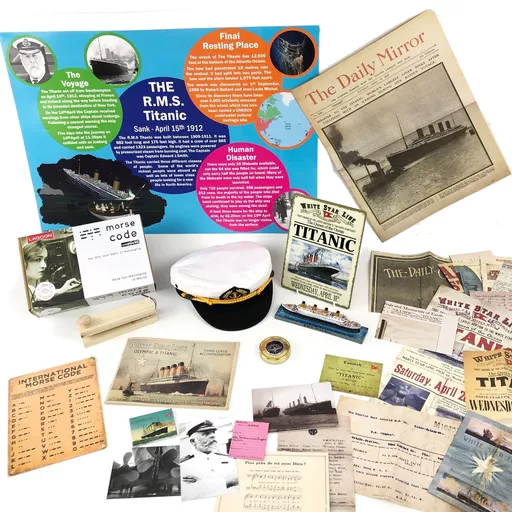
The Titanic
Why it matters historically: The Titanic disaster of 1912 transformed maritime safety regulations, challenged Edwardian confidence in technology and progress, and left an extraordinary human legacy. It is a story of class, ambition, tragedy, and consequence.
Why it works for beyond living memory: The last survivor, Millvina Dean, passed away in 2009. For today's primary school children, this is firmly beyond living memory — and yet it feels vivid and immediate.
Enquiry questions: Why did so many people die on the Titanic? Was it bad luck, bad decisions, or both?
Classroom ideas: Examine the passenger manifest and compare the survival rates of first, second, and third class passengers. Use replica deck plans to explore the ship's layout. Cold water experiments can spark powerful discussion about hypothermia and survival.
Starbeck Education's Titanic resource collection includes replica items such as a first class dinner menu, third class ticket, and passenger boarding cards — these are brilliant for helping children physically handle and compare the experiences of different passengers. Placing a first class menu alongside a third class ticket in children's hands immediately sparks questions about inequality and fairness. Photographs of the ship's interior can then deepen the comparison between luxury above decks and cramped conditions below.
The Great Fire of London
Why it matters historically: Starting in September 1666, the fire reshaped London's physical landscape, led to the development of fire insurance, changed building regulations, and produced one of the most famous eyewitness accounts in English literature — Samuel Pepys' diary.
Why it works for beyond living memory: At over 350 years ago, the Great Fire sits well beyond any living memory, yet it has left behind rich primary sources that children can genuinely access.
Enquiry questions: Why did the fire spread so quickly? What can we learn from Samuel Pepys about what it felt like to live through the fire?
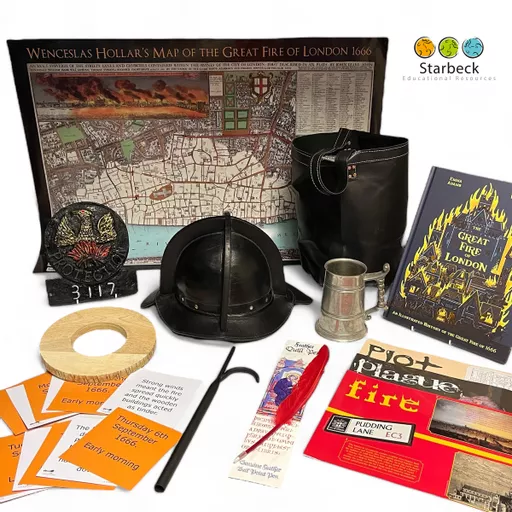
Classroom ideas: Pepys' diary entries read wonderfully aloud and can be adapted for both KS1 and KS2. Build a model of 17th-century London using wooden blocks or cardboard to physically demonstrate how tightly packed the timber-framed buildings were — this makes the speed of the fire's spread immediately understandable.
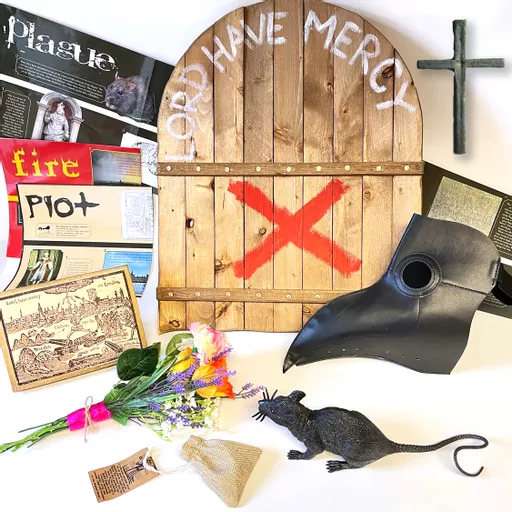
Starbeck Education offers a fantastic Great Fire of London resource pack including a replica Samuel Pepys diary extract, plague doctor items, and period maps of London. Having children annotate replica maps showing the fire's progression, or handle a replica diary page, transforms the topic from a story they are told into evidence they can interrogate. Replica wax seal sets also work beautifully here — children can write their own eyewitness accounts and seal them, just as Pepys might have done.
The Great Plague
Why it matters historically: The bubonic plague of 1665–1666 killed roughly 100,000 Londoners — around a quarter of the city's population. It changed attitudes to public health, sanitation, and the role of civic authorities.
Why it works for beyond living memory: It requires children to use inference and evidence rather than testimony. No one can tell them what it was like; they must work it out from sources.
Enquiry questions: What did people at the time believe caused the plague? What do we know now that they didn't?
Classroom ideas: Examine Bills of Mortality — simplified versions work brilliantly with KS2 children and introduce the idea of using data as historical evidence. The story of Eyam village's voluntary quarantine is deeply moving and resonates powerfully with children, particularly post-pandemic.
Starbeck Education's Great Plague collection includes some genuinely fascinating replica resources — including a plague doctor mask, Bills of Mortality replica documents, and pomander replicas (the scented balls people carried believing they would ward off disease). Passing a replica plague doctor mask around the class and asking Why do you think the doctor wore this? generates incredible discussion about the gap between what people believed and what we now know. It is enquiry-based learning at its most natural and engaging.
The Moon Landing
Why it matters historically: Neil Armstrong's first steps on the Moon in July 1969 represented the pinnacle of the Space Race and marked a defining moment in Cold War history, scientific achievement, and human ambition.
Why it works for beyond living memory: While some older people alive today do remember the Moon Landing, it now sits beyond the living memory of all primary-age children and most of their teachers — making it a useful bridge topic.
Enquiry questions: Why did humans want to go to the Moon? Was the Moon Landing more about science or politics?
Classroom ideas: Watch the actual footage of the landing alongside contemporary news reports and newspaper front pages. Compare the technology of 1969 with technology today — a modern smartphone has significantly more processing power than the Apollo guidance computer, which children consistently find astonishing.
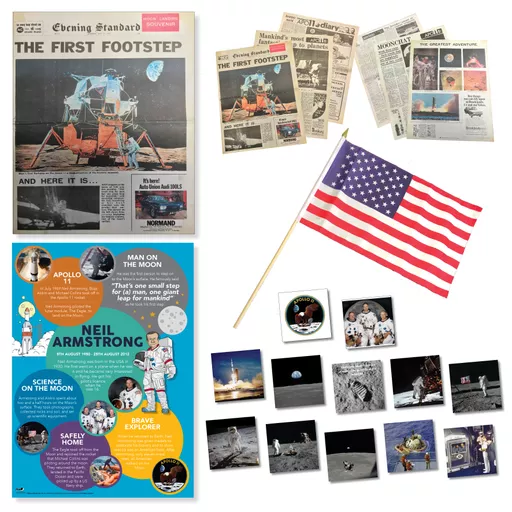
Starbeck Education's Space Race and Moon Landing resources include replica NASA mission patches, Apollo mission documents, and newspaper front page replicas from July 1969. Handing a child a replica of the Daily Mirror front page from 21st July 1969 — "Man Walks on the Moon" — is a simple but extraordinarily powerful moment. It makes the event feel real in a way that a photograph on a screen simply cannot replicate. Children can compare different newspaper front pages and discuss how the event was reported and why it mattered so much to the world.
The Industrial Revolution
Why it matters historically: The Industrial Revolution transformed Britain from a largely rural society to an urban, industrial one. It shaped the landscape, social structures, working conditions, and everyday life in ways still visible today.
Why it works for beyond living memory: It spans roughly 1760–1840, meaning it is entirely beyond living memory, yet its physical legacy — canals, mills, terraced housing — is visible in most British towns and cities.
Enquiry questions: Did the Industrial Revolution make life better or worse for ordinary people?
Classroom ideas: Visit a local mill, canal, or industrial museum where possible — the physical environment of the Industrial Revolution is still visible across much of Britain. Study census records from the period to explore the lives of child workers, and compare maps showing your local area before and during industrialisation.
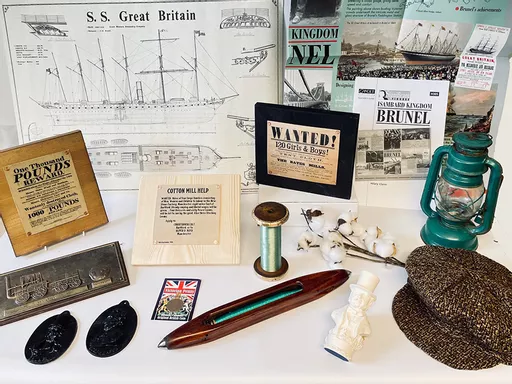
Starbeck Education's Victorian and Industrial Revolution resource range includes replica factory employment notices, child labour documents, and Victorian census extract replicas. These are particularly powerful for KS2 enquiry work. Placing a replica notice advertising jobs for children as young as six in a cotton mill in front of a class of nine and ten year olds never fails to provoke a strong emotional and intellectual response — and strong emotion is often where the best historical thinking begins.
Florence Nightingale
Why it matters historically: Florence Nightingale (1820–1910) transformed nursing and hospital care, pioneered the use of statistics in public health, and remains one of the most significant reformers in modern medicine.
Why it works for beyond living memory: She is an ideal KS1 significant individual — her story is accessible, her impact is clear, and she left behind excellent primary sources including letters, reports, and the famous polar area diagram.
Enquiry questions: How did Florence Nightingale change the way we care for sick people?
Classroom ideas: Role-play a hospital ward comparison — before and after Florence Nightingale's reforms — works brilliantly with KS1 and lower KS2. Examine her famous polar area diagram with older pupils as an outstanding example of presenting evidence visually to persuade decision-makers.
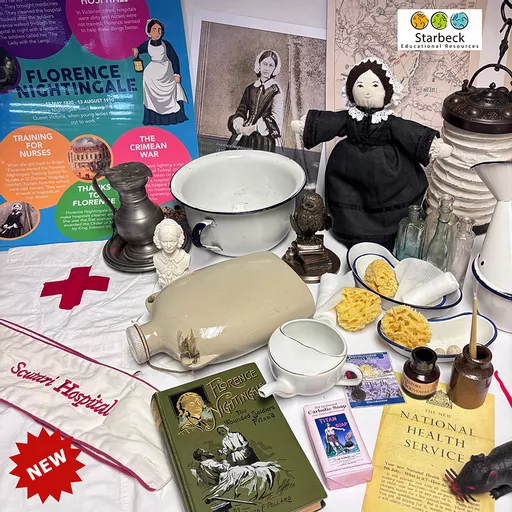
Starbeck Education's Florence Nightingale collection includes replica letters written by Nightingale herself, a replica of her famous lamp, and period nursing documents. A replica of her lamp on the table during a lesson instantly creates atmosphere and gives children a focal point for discussion. Her replica letters can be read aloud or used as sources for written analysis — What does this letter tell us about Florence Nightingale? What doesn't it tell us? Even KS1 children can engage meaningfully with adapted versions of her writing when they have a physical object to anchor the discussion.
The Victorians
Why it matters historically: The Victorian era (1837–1901) is one of the most transformative periods in British history, encompassing industrialisation, empire, scientific discovery, social reform, and enormous changes to everyday life.
Why it works for beyond living memory: It offers enormous breadth and depth, and its physical legacy — schools, hospitals, railways, post boxes — is all around us.
Enquiry questions: What was life like for a Victorian child? In what ways is it similar to or different from your life today?
Classroom ideas: Victorian school lessons — complete with slates, copybooks, and strict classroom rules — are a perennial classroom favourite that never loses its impact. Old photographs, census records, and Victorian household objects all open up rich discussions about continuity and change.
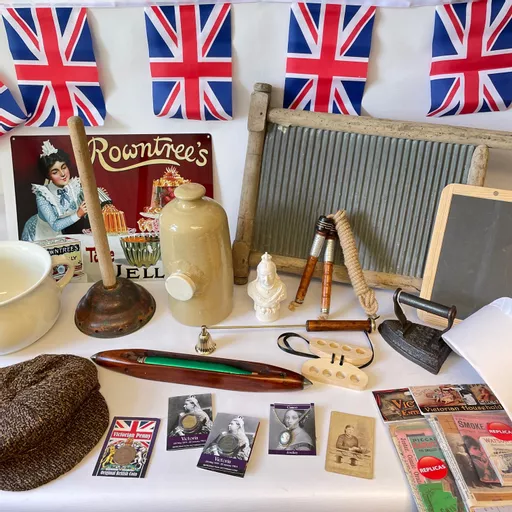
Starbeck Education's Victorian classroom resource collection is one of their most comprehensive ranges, including replica Victorian school slates, copybooks, a Victorian timetable, penny coins, and household object replicas. Running a genuine Victorian-style lesson — where children must sit up straight, copy from the board with a slate, and address the teacher formally — is one of those memorable experiences children talk about for years. Following it with a discussion about What was the same? What was different? Would you have preferred school then or now? builds exactly the kind of chronological and comparative thinking the curriculum demands.
Developing Historical Skills Through These Topics
Across all these topics, you have opportunities to develop core historical skills:
Chronological understanding: Use class timelines that grow throughout the year. Help children understand that the Great Fire (1666) came before Florence Nightingale (1820) and before the Titanic (1912). Physical, washing-line timelines with pegs and cards are particularly effective.
Historical enquiry: Teach children to ask How do we know? at every turn. Who wrote this? When? Were they there? Why might they have written it?
Continuity and change: Ask: What has stayed the same since Victorian times? What has changed? This builds sophisticated thinking even in young children.
Primary and secondary sources: Samuel Pepys' diary is an outstanding primary source accessible even to KS1 (in adapted form). Photographs, maps, official records, and artefacts all serve as primary sources. Textbooks and information books are secondary. Children should understand the difference and why it matters.
The Power of Hands-On Learning
There is something extraordinary that happens when a child holds a Victorian penny, traces the outline of a plague doctor's mask, or places a replica compass on a table and imagines a sailor aboard the Titanic. Abstract history becomes concrete and emotionally real.
Classroom artefacts, historical replicas, and models give children a physical anchor for their historical thinking. They slow children down — encouraging observation, questioning, and
inference in ways that textbooks alone rarely achieve. A replica wax seal prompts How was this made? Who used it? Why? before a single word of text has been read.
Many teachers build up collections of period objects over time, and museum loans, school visits, and high-quality replica resources can all supplement what you have available. The investment is always worthwhile.
Supporting Both KS1 and KS2
The same topic can — and should — be taught very differently across year groups. For KS1, the Great Fire of London might focus on the story of Thomas Farriner's bakery, the experience of Pepys, and a simple before-and-after comparison. For KS2, the same topic could involve analysing multiple sources, debating the causes, and placing the fire within the broader context of Stuart England.
Scaffold the concepts, not the curiosity. Children at any age are capable of genuine historical thinking when the questions are well-framed and the resources are well-chosen.
A Note on Using Replica Artefacts Effectively.
Across all of these topics, the principle is the same: physical objects slow children down in the best possible way. When a child holds something — even a high-quality replica — they observe more carefully, ask better questions, and make stronger connections than they would looking at an image on a screen.
Starbeck Education's replica resources are designed specifically with primary history teaching in mind, making them a practical and educationally sound investment for any school history cupboard. Whether you are just starting to build your collection or looking to add depth to existing resources, their range covers the key topics across KS1 and KS2 with impressive breadth.
Browse their full collection at starbeck.education — you may well find exactly what your next history lesson needs.
Happy teaching — and happy history making.